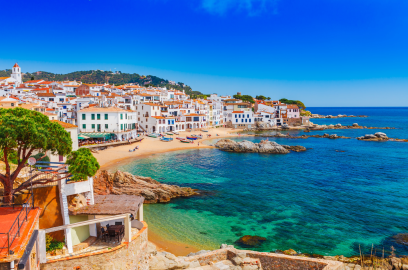
The Non-Lucrative visa is a Spanish visa for financially independent individuals and is currently one of the best immigration routes to Europe. To obtain a residence permit in Spain under this visa category, you do not need to work, purchase expensive real estate, start your own business or make large investments in the country’s economy. With the help of a Non-Lucrative visa, citizens of countries that are not part of the EU can move to Spain.
The Spanish residencia no lucrativais suitable for those who are attracted by a leisurely and comfortable lifestyle in a prosperous European country with a mild climate and who do not need to work or do business to achieve this.
The main advantages of a Non-Lucrative visa
A relatively simple way to move to Spain legally
The Spanish immigration authorities impose minimal requirements on applicants for a financially independent visa.
The opportunity to bring your family with you
In 2026, the Non-Lucrative visa will allow you to bring your spouse, civil partner and children with you to Spain.
Freedom to travel throughout Europe
Once they have obtained a Spanish residence card, holders of a visa for financially independent persons can freely visit the 29 European countries in the Schengen area.
Access to education and healthcare
By moving to Spain on a Non-Lucrative visa, you will be able to take advantage of the country’s high-quality and relatively inexpensive healthcare system. Your children will receive a modern education at numerous educational institutions throughout the Spanish kingdom.
Opportunity to change immigration status
After spending one year in Spain, a financially independent immigrant has the opportunity to switch to a different visa category. To do so, they do not even need to leave the country.
A quick way to obtain a European residence permit
The decision on an application for a Non-Lucrative visa takes no more than 3 months. With the reliable support of our company’s specialists, you can obtain a Spanish residence card within 1-2 months after receiving an entry visa. As of 2026, the Spanish immigration programme for financially independent individuals is one of the fastest ways to obtain a residence permit in Europe.
Prospect of obtaining permanent residence and citizenship
Another advantage of this immigration route is that after spending 5 years in the Kingdom of Spain as a financially independent person, you can apply for a permanent residence permit. After 10 years of living in Spain, you will be eligible to apply for citizenship.
Who is the Non-Lucrative visa suitable for?
The following people can move to Spain on a financially independent visa:
pensioners;
investors, recipients of interest on bank deposits and rentiers;
families with capital who are planning to move abroad without running a business;
Sought-after professionals with personal savings or passive sources of income who are planning to take a break from work and live in Europe for a while.
The Spanish authorities grant a Non-Lucrative visa residence permit to foreign citizens who can prove that they have sufficient financial resources to live in the country. Compliance with the financial requirements is confirmed by documents that our specialists will help you prepare.

Financial requirements for applicants for a Non-Lucrative Visa
Such immigrants can cover their expenses in Spain from the following sources:
Regular income from passive sources abroad. These include pensions, government benefits, dividends, investment income, royalties and rent from rented property.
Amounts in a bank deposit account – the applicant’s personal savings or money received from the sale of property, such as a house.
In order for the application to be approved, the visa applicant must show the Spanish immigration authorities either a sufficient amount in the deposit account or proof of regular passive income.
How much money should the applicant have?
The Spanish authorities regulate the minimum amount of income that the applicant must regularly receive from passive sources, or the minimum amount of savings in their bank account to cover the cost of living in the country for 12 months.
To calculate these minimums, Spain uses the IPREM – Indicador Público de Renta de Efectos Múltiples. At the beginning of 2026, it should correspond to an income of €600 per month or €7,200 per year.
An applicant for a financially independent visa must prove that they regularly receive at least 400% of the IPREM from passive sources. During the year prior to applying for a visa, at least €2,400 per month must be deposited into their account.
In the documents you provide as proof of your stable income, Spanish immigration authorities will not only look at regular deposits into your account but will also closely examine the nature of these deposits.
If personal savings are used to obtain a visa, the amount in the bank deposit is also calculated according to the principle of 400% IPREM and will amount to €28,800 for one year.
How much savings does a family applicant need to show?
Adding a relative to a Non-Lucrative visa application leads to an increase in the financial requirement. To the already calculated 400% IPREM, 100% IPREM is added for each additional dependent in the application, regardless of their age.
| Type of applicant | Amount of savings | ||||
| Residence permit for 1 year | Residence permit extended for 2 years | ||||
| as a % ofIPREM | in euros | as a % of IPREM | in euros | ||
| Main applicant | 400% | €28,800 | 400% × 2 | €57,600 | |
| Spouse/partner | 100 | €7,200 | 100% ×2 | €14,400 | |
| Child | 100 | €7,200 | 100% × 2 | €14,400 | |
A Non-Lucrative visa residence permit is issued for 2 years, so one applicant must prove financial solvency for the entire period — at least €57,600 in the account.
Example of the minimum amount of savings required to obtain a residence permit in Spain for a family of 3
The main applicant must show at least 400% of the IPREM, which at the beginning of 2026 is €28,800, plus an additional 100% of the IPREM (€7,200) for his wife and another 100% of the IPREM (€7,200) for each school-age child he is taking with him to Spain.
Thus, the minimum amount of savings that must be demonstrated to the Spanish immigration authorities for the family to move will be:
Σ = €28,800 + €7,200 + €7,200 = €43,200
How much money must a financially independent person have in their account in order to renew their Spanish residence card?
Since a Non-Lucrative visa is usually extended for 2 years, the financial requirements are doubled – a wealthy immigrant will need to show at least €57,600 in their account.
What restrictions apply in Spain to holders of visas for financially independent persons?
The following restrictions apply to Non-Lucrative visa holders:
You cannot be employed in Spain or earn money in the country as a self-employed person.
You cannot work remotely as a self-employed person or as an employee of a foreign company.
You cannot engage in entrepreneurial activity, but you are allowed to own shares in a business and receive dividends.
A financially independent resident of foreign origin must stay in the Kingdom of Spain for at least 183 days a year if they want to renew their residence permit.
If an immigrant travels to Spain with minor children, they must be enrolled in one of the local schools.
Immigration route for holders of a financially independent visa
Upon arrival in Spain, the holder of a Non-Lucrative visa applies for their first residence permit, which is valid for 12 months.
If the foreigner does not violate the requirements set out in the previous section, continues to receive passive income and/or has sufficient funds in their bank accounts, after one year they will be able to apply for an extension of their immigration status. The extended residence card is valid for 2 years.
Five years of residence in Spain – one year on the first residence permit and two renewals for two years, give immigrants the opportunity to apply for a permanent residence permit. However, it should be noted that in order to obtain permanent resident status, they must integrate into the local community and have a good command of Spanish not lower than level B1 according to the classification accepted in Europe.
After living in the country for 10 years, a permanent resident can obtain citizenship through naturalisation.
Exceptions to this rule are made for nationals of Portugal, Andorra, Latin American countries, the Philippines and Equatorial Guinea, as well as Sephardic Jews, who are eligible to apply for citizenship after two years of residence in the Kingdom of Spain.
What documents will an applicant for aNon-Lucrative visa need?
During the preparatory stage, you should gather a package of documents, including:
Visa application form (official form EX-01).
Passport and copies of all its pages. Please note the validity period of your passport, as the Spanish consulate has restrictions on the date of issue (no more than 10 years ago) and the validity period of this document (at least 1 year).
Photographs (3.5 cm × 4.5 cm format is acceptable).
Documents confirming your financial situation. Applicants for a Non-Lucrative visa must provide documentary evidence that they have sufficient funds to support themselves throughout their stay in Spain.
The following documents are acceptable for this purpose: bank statement, certified debit card cheques, asset certificates, etc.
Pensioners, rentiers, investors, and co-owners of foreign and Spanish companies must prove that they have a regular passive income that meets the minimum financial requirements.
Attach statements from your bank accounts for the last 3 months and a copy of your latest tax return to the documents already listed.
Medical insurance. Purchase commercial insurance that will cover all basic medical expenses in Spain, including emergency care and hospitalisation, for 12 months.
Medical certificate confirming the absence of dangerous infectious diseases.
Certificate of no criminal record. Applicants who have reached the age of criminal responsibility must present a certificate from the police confirming that they have no criminal record. This document must be requested from each jurisdiction where you have lived for a long period of time during the last 5 years. The certificate of no criminal record must be apostilled and translated into Spanish.
Document confirming payment of the registration fee – form 790-052.
If you are moving to the Kingdom of Spain with your family, you will need to prepare:
- for spouses – a marriage certificate;
- for unregistered partners – proof of a long-term relationship;
- for children – birth certificate.
Most of these documents must be apostilled. All documents in a foreign language must be translated into Spanish by a certified translator who is officially licensed by the Spanish Ministry of Justice. Therefore, the preparatory stage often takes a long time for inexperienced applicants. The process of preparing documents for a Spanish visa becomes much easier with the qualified assistance of Imperial & Legal consultants.
Who can a financially independent person include in their application for a Spanish visa?
This immigration route allows the following relatives to be included in a Non-Lucrative visa application:
Spouse, civil partner or permanent unregistered partner (if they can properly prove a long-term relationship).
Minor children.
Adult children, if they have a disability and are unable to support themselves at the time of application and are dependent on their parents.
Algorithm for obtaining a non-lucrative visa to Spain
What assistance does Imperial & Legal provide to applicants for a Non-Lucrative visa?
Our employees take a comprehensive approach, involving maximum participation at every stage of the visa application process. By contacting us, clients receive a ready-made, turnkey solution. What services do we provide to pensioners, investors and simply wealthy families applying for a Spanish visa for financially independent persons?
1. Consultations and strategy selection
consultations on the conditions for obtaining a Non-Lucrative visa and financial requirements;
checking the client’s eligibility for this visa: examining sources of passive income, personal savings accounts;
development of a personalised strategy for obtaining a visa;
consultations on taxation in Spain.
2. Preparation of documents
collection, legalisation and translation of documents;
checking the entire package of documents for compliance with consulate requirements.
3. Financial issues
assistance with confirming passive income;
competent structuring of client assets for the purpose of obtaining a visa to Spain;
requesting and verifying the necessary certificates and bank statements.
4. Medical insurance
selection and registration of medical insurance from a reliable company operating in Spain that can cover potential medical expenses in this country.
5. Search, rental or purchase of real estate
search for and selection of suitable rental accommodation for the client;
organising viewings, legal support for the purchase of houses and flats in Spain;
Assistance in obtaining a residence permit, which is necessary to apply for a Spanish residence card.
6. Support insubmittinganapplication
completion of the EX-01 application form, payment of the registration fee 790–052;
organising an interview at the BLS or the consulate;
negotiating with the consulate on behalf of the client on all issues arising after the application has been submitted.
7. Support during the process of moving to Spain
organising a comfortable move to Spain;
assistance in obtaining a residence card;
assistance in extending the residence permit: documentary confirmation of the client’s stay in the country for more than 183 days, collection of school certificates for children;
consultations on switching to a resident visa with the right to work , if necessary.
8. Long-term cooperation
If you plan to spend the rest of your life in Spain, with the help of our company you can successfully solve such tasks as:
obtaining permanent residence and Spanish citizenship;
taxplanning;
business structuring and competent registration of property rights, relevant for investors.
No matter how complex the tasks in Spain may be, financially independent immigrants will always find reliable assistants in the employees of Imperial & Legal!